01 Sep

FatPipe’s Network Topology Visualization: The Constellation Advantage

Network Topology Visualization

Many organizations need precise network topology visualization through a single pane of glass to give context to incidents. FatPipe helps bring the network visibility and sophistication available to large enterprises within reach of smaller businesses.

Giving a small business capabilities traditionally associated with a large enterprise can deliver significant value. However, greater visibility should never mean greater exposure. That is why FatPipe establishes cybersecurity capabilities as a foundation before adding the broader network monitoring layer. This approach allows organizations to expand visibility within an already security-focused environment.

For larger businesses, the same approach helps maintain the visibility, control, and operational awareness they expect while bringing increasingly distributed network resources into one cohesive view.

The Constellation Effect: Turning Network Complexity into Instant Clarity

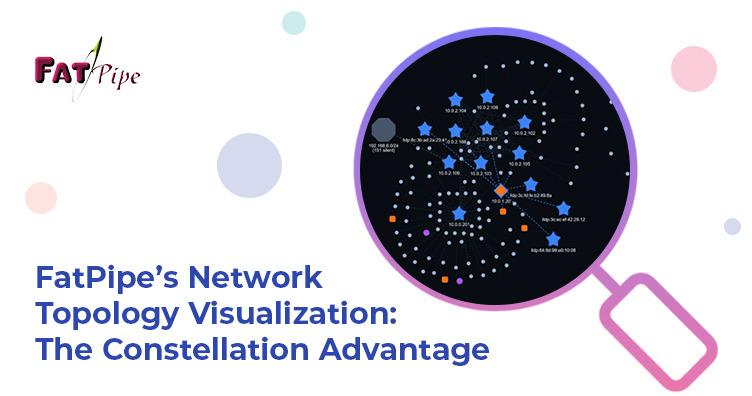
FatPipe’s philosophy has always been to make complex networks easier to understand and manage. A network can contain hundreds or thousands of devices, interfaces, connections, and paths. Viewing these elements independently provides only part of the picture. FatPipe’s network topology view brings them together and presents the network as a connected constellation.

  • Rather than moving among multiple dashboards to determine what is connected, what has changed, or where an issue may exist, administrators gain a consolidated view of the network topology.
  • A current network map is useful. Understanding how the network has changed over time makes it considerably more valuable.
  • Administrators can compare topology states to identify new or removed devices, devices that are no longer connected, and devices with intermittent or fluctuating connectivity. This perspective helps teams distinguish an established network condition from a recent change and provides additional context when investigating connectivity issues.
  • The result is a complete network topology presented as an interactive, navigable map. Devices appear as nodes, while the connections between them appear as edges or links. Together, they create a visual representation of the network fabric, helping administrators understand not only which devices exist, but  how those devices relate to one another.
  • Administrators can see what is on the network, understand how everything connects, and replace scattered dashboards with one cohesive view.
  • The FatPipe Constellation topology view brings devices, links, operational states, and historical topology changes into one connected visual experience. Smaller organizations gain access to the type of network visibility generally associated with larger enterprises, while larger organizations retain the cohesive operational view required to manage increasingly distributed environments.

FatPipe’s network topology visualization is more than a map. It provides a clearer way to see what is on the network, how everything connects, what has changed, and where attention may be needed.

If your team is struggling to monitor everything across a growing network, FatPipe can help. Constellation reduces dependence on time-consuming manual checks and gives administrators the context they need to investigate alerts, incidents, and customer complaints more efficiently.

Contact FatPipe today to schedule a demonstration and see how Constellation can simplify network monitoring.

21 Aug

Clarity and Confidence: Transforming Compliance Reporting with FatPipe

For enterprises, the need to protect sensitive data, manage cyber risk, and demonstrate adherence to applicable regulatory and security requirements has become a critical business priority; it is now an important key responsibility area for Chief Information/ Security Officers. Compliance reporting enables organizations to demonstrate that their security, privacy, and data protection controls are not only defined but also implemented and operate effectively. Regulations and frameworks such as GDPR in the EU, NIST in the U.S. and HIPAA for U.S. healthcare organizations provide the necessary requirements and guidance for protecting sensitive information and managing cyber risk. Compliance reports provide auditable evidence of these controls, highlight gaps and support regulatory oversight, customer assurance and internal governance. And therefore, even a small lack of clarity can create confusion or disappointment.

FatPipe Compliance Reports – Enforcing Factual Hygiene and Granularity

  • FatPipe compliance reports present the cold, hard data needed to protect and grow the company.
  • A compliance report is only valuable as the evidence behind it and the accountability it creates.

FatPipe structures compliance reporting across multiple levels of detail: Framework -> Domain -> Control/Requirement -> User -> Event. This allows users to move from a high-level compliance view to the specific requirement, accountable user, and underlying security event.

Reports Tailored for Different Industries

FatPipe’s value to customers is not only about the variety of frameworks. It is depth and the ability to connect framework-level reporting with controls, users, and the events behind them.

FatPipe compliance reports provide structured visibility across NIST, HIPAA, PCI DSS, GDPR, and TSC/SOC 2, organizing relevant security events according to the requirements of each framework. This helps organizations review compliance-related activity in a form that is easier to interpret, document, and act on. Rather than treating compliance as a collection of isolated checks, the reports present framework-aligned findings in a consistent view that supports ongoing reviews and audit preparation.

Faster, Cleaner, and Audit-Ready Compliance Decisions

  • Simple format so that even busy readers can make quick decisions by just scrolling through
  • Is highly relevant to major industries, including healthcare, banking and finance, education, and hospitality.
  • Easily configurable Graphical User Interfaces
  • Clearly surface compliance gaps, failed controls, and unresolved issues.
  • Helps generate reports as needed, retrieve them as PDFs, and print or archive them for audits, reviews, and record keeping.

Too much compliance effort is even now spent manually combining scattered security data into something meaningful and defensible.

According to a comprehensive annual study analyzing global security, risk, and compliance trend, 76% of security and compliance teams are seeking to reduce employee burnout. This concern is acceptable, as they can focus on more strategic priorities. More importantly, manual effort should not come at the expense of the clarity decision-makers need. Let FatPipe’s SIEM do the heavy lifting by turning security data into verified, audit-ready evidence for compliance reporting, identify control gaps and support regulatory, customer as well as internal governance requirements.

13 Aug

From Day One: The Unmistakable Constellation Difference

Cybersecurity may evolve rapidly, yet knowing what assets exist remains a prerequisite for protecting them. Networks are no different.

Constellation Difference

Network Monitoring Is About Context, Not Merely Status

CISA identifies continuous, comprehensive asset visibility as a basic precondition for effectively managing cybersecurity risk. NIST’s current cybersecurity guidance also begins with identifying and maintaining an inventory of the assets an organization depends on.

But knowing what should be there is only half the picture. Next, you need to determine what is actually on the network. Then go further. Can you reach those assets, and are they responding? What should you measure? What traffic is moving through the network? What requires attention? Has this happened before?

Each question brings you closer to the necessary context, transforming isolated monitoring signals into a more complete understanding of what is happening across your network.

Knowing whether a device is up or down is only the starting point. Meaningful network monitoring provides the context behind that status: how devices are connected, how they are performing, what traffic is moving through them, what conditions triggered an alert, and whether similar events have occurred before. Status tells you what happened. Context helps you understand why it matters and where to look next.

Different signals. One connected view.

A new Constellation is taking shape.

Technologies Have Generations. Operational Realities Remain at the Core of Network Monitoring.

Network technologies change rapidly, but the operational realities of managing a network evolve much more slowly. Devices still need to be discovered, relationships understood, performance measured, traffic interpreted, anomalies detected, and events placed in context. FatPipe understands that these customer challenges persist regardless of how the underlying technologies evolve.

Constellation is different because it returns to these enduring operational realities and connects them with the visibility modern networks make possible.

Technologies evolve. Operational realities are by and large constant. Constellation provides the connected visibility needed to understand them. The realities are not new. Seeing them together is.

04 Aug

Every Alert Matters: Proactive Alert Management for Resilient Networks

In a world where networks support everything from patient care to financial transactions, waiting for users to report a problem is no longer acceptable. Effective alert management, supported by proactive alerts and clearly defined severity levels, is the foundation of a strong network monitoring strategy.

Severity levels help network teams understand the significance of an event and respond with the appropriate priority. They remove the tension from the NOC teams and network administrators, giving peace of mind that they can handle a condition well, especially one that requires immediate attention.

Severity Levels for the Right Operational Context

At FatPipe, these severity levels are designed to give every alert the right operational context. The goal is not simply to generate notifications, but to help teams understand what happened, how significant it is, and what response is appropriate. While FatPipe supports a broad range of alert triggers across the network, those events are organized into four clear severity levels, Critical, Major, Warning, and Info, to make prioritization simpler and more actionable.

FatPipe EnterpriseView: Precision Alert Configuration

FatPipe EnterpriseView (EV) enables administrators to configure alert rules across network entities and assign severity levels based on the potential impact of each event.

Event detected → Severity level assigned → Events tracked by severity → Right team notified → Priority-based action taken

Alert triggers can cover device availability, connectivity, performance, and security conditions. This range is important because modern networks contain numerous devices, links, applications, and services that must be monitored at the same time.

An important unmonitored condition can create a blind spot that allows a performance issue, outage, or security event to go unnoticed. Comprehensive alert configuration helps network teams identify these conditions before they cause a larger disruption.

 When an alert is triggered, EnterpriseView can notify the appropriate personnel by SMS or phone, helping teams respond even when they are away from the monitoring console.

FatPipe’s alert framework has been shaped by years of customer feedback, real-world network incidents, and changing security requirements. Severity levels determine response priority, while detailed reporting helps ensure that events remain visible, documented, and actionable.

Alerts create value only when they lead to the right action. Effective alert management is not about generating the largest number of notifications. It is about understanding what occurred at each severity level and giving the right people enough information to act before an issue becomes a serious outage or security incident.

27 Jul

Seamless Failover, Unbroken Sessions: Elevating Unified Communications with FatPipe

Microsoft Teams has more than 320 million monthly active users. When a call drops, video stutters, or audio cuts out, users often blame the conferencing platform or the IT team. But one fundamental truth is frequently overlooked: the quality of unified communications is only as good as the network carrying it.

 Consider what happens when communications fail:

  • When a call drops, users blame the network team.
  • When video quality deteriorates, they blame the conferencing platform.
  • When a contact center interaction fails, the UCaaS provider takes the reputational hit.

This is where FatPipe provides value.

FatPipe’s patented technology addresses network problems at their source, helping conferencing platforms, UCaaS providers, and network administrators deliver a more consistent experience. When the underlying network performs reliably, the communications platform receives the credit it deserves, and the organization gets the service quality it is paying for.

The Two Pillars: Seamless Failover and Session Persistence

At the heart of FatPipe’s technology are two closely connected, patented capabilities: seamless failover and session integrity. Together, they deliver what we call absolute session persistence.

FatPipe continuously monitors all available WAN links for latency, jitter, packet loss, and overall health. When a link begins to degrade, even before it fails completely, FatPipe proactively moves traffic to a healthier path. There is no need to wait for a complete failure or for someone to intervene manually.

The response is immediate and invisible with Zero Request Timeouts with sub second seamless failover without traffic duplication on links, saving upto 50% of the bandwidth costs.

During a failover event, FatPipe preserves the state of active connections. A VoIP call continues without dropping. A video conference proceeds without freezing. A contact center interaction continues without the customer knowing that the underlying network path has changed.

Intelligent Path Selection: Putting Customers in Control

FatPipe gives organizations direct control over how critical application traffic travels across the WAN. Administrators can:

  • Direct VoIP traffic over the lowest-latency path.
  • Prioritize video conferencing on the highest-bandwidth link.
  • Separate contact center traffic from large data transfers.

This level of control improves application performance and helps traffic take the most efficient route between locations without being forced through unnecessary intermediate points. The result is lower latency, reduced jitter, fewer dropped packets, and a better overall communications experience.

These capabilities are also designed to provide a lower total cost of ownership than traditional network architectures. Network and application administrators gain greater control, improved reliability, and the peace of mind that comes from knowing critical communications can continue through link degradation or failure.