08 Sep

Operational Readiness Beyond POTS: Practical Recommendations
Operational readiness beyond

The copper networks that carried analog phone lines for generations are being retired. For decades, these networks quietly supported not only desk phones, but elevator emergency phones, fire alarm communicators, fax machines, security systems, and other equipment that organizations rarely considered until a line stopped working. That equipment may still function perfectly, but the communications infrastructure supporting it is disappearing.

This transition is no longer a future consideration. Carriers are shifting investment from aging copper networks to fiber, broadband, and 5G, while regulatory changes are making it easier to retire legacy infrastructure. Organizations must identify and replace their remaining POTS lines before a carrier discontinues service and an overlooked analog connection creates an operational problem.

FatPipe’s Role in the Copper Retirement Journey

Replacing POTS should not require replacing every device connected to it. Existing elevator phones, alarm panels, fax machines, and other POTS-dependent equipment may still have years of useful life remaining. A more practical approach is to modernize the connectivity that supports these devices.

FatPipe provides a resilient solution that enables a seamless transition from legacy POTS to a ported digital solution running over 5G/LTE or fiber.

Continuity Is Non-Negotiable

Copper retirement can turn a routine telecommunications decision into a life-safety and compliance matter. Elevator phones, fire alarm communicators, emergency phones, and similar systems may be subject to requirements for line supervision, emergency calling, backup power, and approval by the applicable Authority Having Jurisdiction. A replacement must therefore preserve more than a dial tone. It must maintain the underlying service’s availability and operating requirements.

This is where WAN resilience becomes especially important. A modern solution should not replace one aging connection with another single point of failure. FatPipe’s POTS Replacement solutions provide a wireless upgrade to legacy copper connections. 

For organizations in healthcare, banking and ATM services, education, hospitality, government, and other multi-site environments, the stakes can be significant. The goal is no longer to replace an old copper line. It is to preserve the critical service that depended on it while providing a more resilient connectivity foundation for the future. All-in-one POTS replacement solutions are available from providers such as LineBridge and other FatPipe partners.

01 Sep

FatPipe’s Network Topology Visualization: The Constellation Advantage

Network Topology Visualization

Many organizations need precise network topology visualization through a single pane of glass to give context to incidents. FatPipe helps bring the network visibility and sophistication available to large enterprises within reach of smaller businesses.

Giving a small business capabilities traditionally associated with a large enterprise can deliver significant value. However, greater visibility should never mean greater exposure. That is why FatPipe establishes cybersecurity capabilities as a foundation before adding the broader network monitoring layer. This approach allows organizations to expand visibility within an already security-focused environment.

For larger businesses, the same approach helps maintain the visibility, control, and operational awareness they expect while bringing increasingly distributed network resources into one cohesive view.

The Constellation Effect: Turning Network Complexity into Instant Clarity

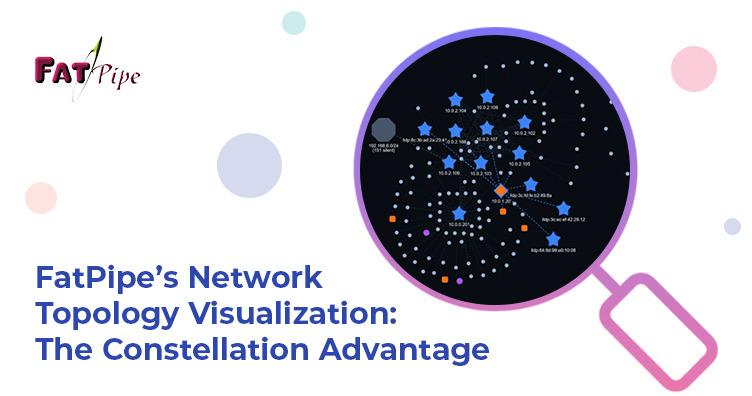
FatPipe’s philosophy has always been to make complex networks easier to understand and manage. A network can contain hundreds or thousands of devices, interfaces, connections, and paths. Viewing these elements independently provides only part of the picture. FatPipe’s network topology view brings them together and presents the network as a connected constellation.

  • Rather than moving among multiple dashboards to determine what is connected, what has changed, or where an issue may exist, administrators gain a consolidated view of the network topology.
  • A current network map is useful. Understanding how the network has changed over time makes it considerably more valuable.
  • Administrators can compare topology states to identify new or removed devices, devices that are no longer connected, and devices with intermittent or fluctuating connectivity. This perspective helps teams distinguish an established network condition from a recent change and provides additional context when investigating connectivity issues.
  • The result is a complete network topology presented as an interactive, navigable map. Devices appear as nodes, while the connections between them appear as edges or links. Together, they create a visual representation of the network fabric, helping administrators understand not only which devices exist, but  how those devices relate to one another.
  • Administrators can see what is on the network, understand how everything connects, and replace scattered dashboards with one cohesive view.
  • The FatPipe Constellation topology view brings devices, links, operational states, and historical topology changes into one connected visual experience. Smaller organizations gain access to the type of network visibility generally associated with larger enterprises, while larger organizations retain the cohesive operational view required to manage increasingly distributed environments.

FatPipe’s network topology visualization is more than a map. It provides a clearer way to see what is on the network, how everything connects, what has changed, and where attention may be needed.

If your team is struggling to monitor everything across a growing network, FatPipe can help. Constellation reduces dependence on time-consuming manual checks and gives administrators the context they need to investigate alerts, incidents, and customer complaints more efficiently.

Contact FatPipe today to schedule a demonstration and see how Constellation can simplify network monitoring.

04 Aug

Every Alert Matters: Proactive Alert Management for Resilient Networks

In a world where networks support everything from patient care to financial transactions, waiting for users to report a problem is no longer acceptable. Effective alert management, supported by proactive alerts and clearly defined severity levels, is the foundation of a strong network monitoring strategy.

Severity levels help network teams understand the significance of an event and respond with the appropriate priority. They remove the tension from the NOC teams and network administrators, giving peace of mind that they can handle a condition well, especially one that requires immediate attention.

Severity Levels for the Right Operational Context

At FatPipe, these severity levels are designed to give every alert the right operational context. The goal is not simply to generate notifications, but to help teams understand what happened, how significant it is, and what response is appropriate. While FatPipe supports a broad range of alert triggers across the network, those events are organized into four clear severity levels, Critical, Major, Warning, and Info, to make prioritization simpler and more actionable.

FatPipe EnterpriseView: Precision Alert Configuration

FatPipe EnterpriseView (EV) enables administrators to configure alert rules across network entities and assign severity levels based on the potential impact of each event.

Event detected → Severity level assigned → Events tracked by severity → Right team notified → Priority-based action taken

Alert triggers can cover device availability, connectivity, performance, and security conditions. This range is important because modern networks contain numerous devices, links, applications, and services that must be monitored at the same time.

An important unmonitored condition can create a blind spot that allows a performance issue, outage, or security event to go unnoticed. Comprehensive alert configuration helps network teams identify these conditions before they cause a larger disruption.

 When an alert is triggered, EnterpriseView can notify the appropriate personnel by SMS or phone, helping teams respond even when they are away from the monitoring console.

FatPipe’s alert framework has been shaped by years of customer feedback, real-world network incidents, and changing security requirements. Severity levels determine response priority, while detailed reporting helps ensure that events remain visible, documented, and actionable.

Alerts create value only when they lead to the right action. Effective alert management is not about generating the largest number of notifications. It is about understanding what occurred at each severity level and giving the right people enough information to act before an issue becomes a serious outage or security incident.

20 Aug

Make Your Network Faster with Protocol-Less WAN

The routing protocol has been the technology for running enterprise networks ever since the invention of dynamic routing protocols in the 1980s and 1990s. These protocols are now over 35 years old and have inherent limitations, the most prominent one being control overheads and slow convergence for today’s traffic, which is real-time primarily in terms of voice, video, and cloud applications. The dynamic protocols were more relevant when there was no cloud traffic and very little video and voice content, which is now prevalent with conferencing applications such as Webex, Teams, and Zoom.

Welcome to the world of FatPipe Networks, which manages the modern enterprise network without requiring any dynamic WAN routing protocol. The patented yet open FatPipe WAN Edge overcomes all the inherent limitations of these old routing protocols with MPSECTM, making the network much more reliable, simpler, and faster for mission-critical applications.

FatPipe MPSecTM –  A Trusted Security Feature Propelling Faster, Smarter WANs and Addressing Everyday Connectivity Challenges

MPSec™ powers a routing protocol-less WAN, delivering speed, resilience, and simplified management. It creates multiple secure paths for uninterrupted connectivity and works seamlessly with dynamic IPs under a single IP framework. FatPipe VPN also supports IPSec tunnels to non-FatPipe devices for hybrid deployments. Common issues, such as IPSec tunnel failure or MPSec™ path downtime, make MPSec™ the proven choice for fast, secure, and reliable WANs.

The Defining Factor That Sets MPSecTM a Class Apart from Others

Takes your already encrypted data, breaks it down to the packet level, and randomly sends the packets over multiple lines, where they are reassembled at the receiving end with virtually no latency. This random distribution of packets across multiple paths makes it challenging for attackers to intercept and reconstruct your data, adding an additional layer of security beyond encryption.

Time-Tested Principles for Network Excellence (Enabled by FatPipe):

  • Build Strong Interconnections Between Components: Creates resilience against disruptions and single points of failure through FatPipe’s multipath architecture.
  • Integration of heterogeneous last-mile technologies: Aggregates any last-mile technology into a single, end-to-end IP framework for faster and simpler networking.
  • Breaking Free from Routing Protocol Complexity
  • Eliminate the need for peering and the complex routing overhead exchanges that slow down the network. Move towards ultra-fast and simpler networks through MPSec TM
20 Jun

FatPipe’s Focused Threat Protection with Anti-Virus and Data Loss Prevention–Part II

In the previous blog, we discussed about effective Data Loss Prevention (DLP) from the angle of how data is protected and FatPipe’s crucial role in it. In this blog, we explore the types of sensitive data FatPipe’s antivirus/DLP solution is committed to safeguard.

Safeguard Data, Ensure Compliance, and Strengthen Trust

A strong DLP strategy also involves clearly defining and safeguarding your organization’s most valuable data assets. This includes identifying sensitive data, performing pattern matching, and analyzing signature types.

  • FatPipe intelligently leverages user behavior patterns, signature types, and false positive analysis to fine-tune both custom and predefined DLP configurations.
  • Custom policies foster operational efficiency, while predefined categories ensure swift deployment avoiding the pitfalls of regulatory failures realized only in hindsight.
  • To mitigate insider threats, FatPipe categorizes sensitive data including PII, credentials, financial records, healthcare data, and compliance-related content into granular security labels, ensuring protection against unauthorized access or leakage.
  • Compliance violations are detected using pattern- and signature-based rules.
  • The DLP engine continuously performs tuning of detection across security-critical content with minimal disruption, helping you stay ahead of the curve.
  • Custom policies give the leeway for organizations to tailor rules to their unique needs. Take for example the following: setting up a policy to detect internal project code names in outbound emails or flagging file transfers consisting of company’s confidential designs or scanning uploaded or shared config/text files for hardcoded credentials or API keys that may be exposed accidentally.
  • Predefined templates enable rapid deployment and regulatory alignment. For instance, choosing the healthcare category provides built-in detection rules for PHI, enabling swift deployment aligned with HIPAA-related data types.

By prioritizing DLP, companies protect critical data, simplify compliance, and strengthen brand credibility. FatPipe stays firm in its mission of placing both simplicity and security in equal weight, addressing the growing pains of organizations in maintaining data protection being one of its priorities.