20 Jun

FatPipe’s Focused Threat Protection with Anti-Virus and Data Loss Prevention–Part II

In the previous blog, we discussed about effective Data Loss Prevention (DLP) from the angle of how data is protected and FatPipe’s crucial role in it. In this blog, we explore the types of sensitive data FatPipe’s antivirus/DLP solution is committed to safeguard.

Safeguard Data, Ensure Compliance, and Strengthen Trust

A strong DLP strategy also involves clearly defining and safeguarding your organization’s most valuable data assets. This includes identifying sensitive data, performing pattern matching, and analyzing signature types.

  • FatPipe intelligently leverages user behavior patterns, signature types, and false positive analysis to fine-tune both custom and predefined DLP configurations.
  • Custom policies foster operational efficiency, while predefined categories ensure swift deployment avoiding the pitfalls of regulatory failures realized only in hindsight.
  • To mitigate insider threats, FatPipe categorizes sensitive data including PII, credentials, financial records, healthcare data, and compliance-related content into granular security labels, ensuring protection against unauthorized access or leakage.
  • Compliance violations are detected using pattern- and signature-based rules.
  • The DLP engine continuously performs tuning of detection across security-critical content with minimal disruption, helping you stay ahead of the curve.
  • Custom policies give the leeway for organizations to tailor rules to their unique needs. Take for example the following: setting up a policy to detect internal project code names in outbound emails or flagging file transfers consisting of company’s confidential designs or scanning uploaded or shared config/text files for hardcoded credentials or API keys that may be exposed accidentally.
  • Predefined templates enable rapid deployment and regulatory alignment. For instance, choosing the healthcare category provides built-in detection rules for PHI, enabling swift deployment aligned with HIPAA-related data types.

By prioritizing DLP, companies protect critical data, simplify compliance, and strengthen brand credibility. FatPipe stays firm in its mission of placing both simplicity and security in equal weight, addressing the growing pains of organizations in maintaining data protection being one of its priorities.
09 Jun

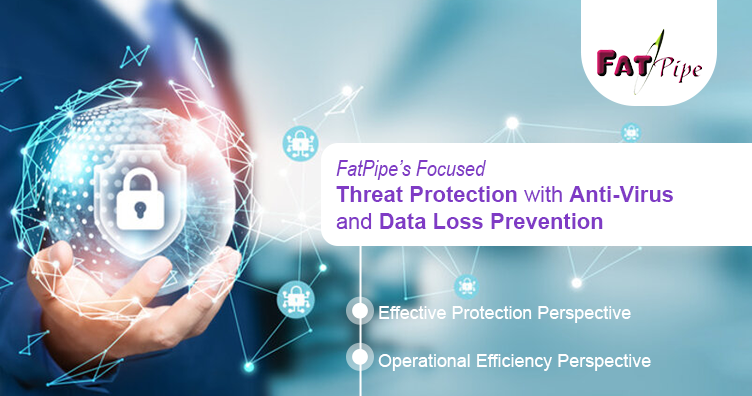
FatPipe’s Focused Threat Protection with Anti-Virus and Data Loss Prevention

As organizations generate and manage digital information at an alarming rate, the demand for risk-aware and visibility-driven DLP systems has never been greater. Data Loss Prevention (DLP) solutions essentially focus on preventing the unauthorized transmission or exposure of sensitive data beyond the realms of an organization, be it through email, web uploads, removable media, or insider misuse.

Balancing Security with Performance: FatPipe’s Smart Approach
While the need for DLP is undeniable, industries often face the challenge of balancing strong protection with operational efficiency. This is precisely where FatPipe makes the difference: delivering powerful, integrated security without compromising on performance. Just take the instance of blocking or scanning of potentially dangerous attachments which aids in preventing data leakage and malware infections. FatPipe can identify and flag suspicious content in files and emails and also scan for known malware, all without slowing business operations. Moreover, FatPipe’s antivirus/DLP offering maintains a reasonable balance between effective protection and operational efficiency. Here’s how FatPipe maintains the right balance:

  • Effective Protection Perspective: Given that today’s threat landscape is hostile, aggressiveness in certain FatPipe’s features only ease the gravity of the situation. Features like MIME type blocking, SMTP relay restrictions, and email file extension control prevent malware infiltration through deceptive attachments and rogue email servers. For example, if not for the restricting capacity that is leveraged while using certain file extensions in email attachments, your organization can easily become a prey of malware or data loss. Throttling risky file types, YouTube restrictions, and caching policies further harden the network against social engineering and bandwidth abuse.
  • Operational Efficiency Perspective: Also given the increased downtime, admin overhead, and need for quick access to trusted resources, FatPipe’s antivirus/DLP protection strategy allows customization or tuning to avoid false positives, is optimized for performance to not overwhelm system resources, is flexible enough to minimize user disruption, is policy-driven, and allows different enforcement levels for different departments or risk levels. For e.g., you can get the benefit of filtering inappropriate YouTube videos without blocking the entire platform, preserving access for business or educational purposes.

FatPipe’s antivirus and DLP solution ensures that an equilibrium is achieved: proactive in protection, yet adaptable in practice. But effective DLP isn’t just about how you protect, it’s also about what you protect. In the second part of this series, we will delve into how FatPipe identifies and protects different types of sensitive data, and how both predefined and custom DLP configurations can be harnessed to align protection with your organization’s unique data ambit and compliance needs.

What Next?

Our advanced Antivirus and DLP solution is a pivotal part of our Cybersecurity product. Keep visiting our resources for more updates on such features, or learn how you can be among the first to experience comprehensive security with endpoint and data protection by reaching us at support@fatpipeinc.com.