10 Jul

MTU, Jumbo Frames, and the Small Decisions That Shape Network Performance

After discussions about DDoS attacks and mitigation, the industry mostly stays focused on the obvious threats: malicious traffic, botnets, volumetric floods, and outages that disrupt the business. Those risks are indeed are of great magnitude. But resilient networks are not built only by defending against the loudest threats. They are also built by paying close attention to the quiet engineering choices that determine how well traffic moves when the network is under pressure.

MTU is one of those choices.

FatPipe’s default MTU is 1500, the widely accepted standard for enterprise connectivity. It is reliable, interoperable, and well suited for most WAN, internet, VPN, cloud, and branch environments. For many administrators, MTU is not a setting that creates daily concern. But when it is configured incorrectly, the impact can be significant.

Poor MTU configuration can lead to fragmentation, retransmissions, dropped packets, slow application response, VPN instability, poor voice or video quality, failed file transfers, and connectivity issues that are difficult to trace. In some cases, traffic may appear to work only partially, which makes the issue even harder to isolate. This is a deep, actionable lesson. Not every performance issue begins as a dramatic outage. Some begin as a simple mismatch. A packet is too large for one segment of the path. A device silently drops fragmented traffic. A tunnel adds overhead that was not accounted for. The underlay may look healthy, but the overlay experience may still suffer because the effective MTU has changed. Suddenly, the network is technically “up,” but the user experience is still unacceptable. In today’s business environment, nothing is trivial, and that difference matters.

Supporting Jumbo Frames with the Right Design

Jumbo frames elevate the MTU discussion to the next level. FatPipe supports jumbo frames up to 9000 bytes, which can be valuable for data centers, storage-heavy environments, healthcare organizations handling imaging files, media and design teams moving large creative assets, research and education institutions working with large datasets, and financial enterprises that need throughput and predictability. In the right environment, jumbo frames can reduce packet overhead and help large trusted traffic move more efficiently.

But jumbo frames are not just a technical setting. They are also a design and governance decision. They require end-to-end consistency, documentation, validation, and change control. In environments where compliance, availability, and predictability matter, a well-intended MTU change that is not validated across the full path can create avoidable risk.

This is where FatPipe’s approach matters. The same principle that applies to intelligent DDoS mitigation also applies to MTU and jumbo frame design: understand the traffic, understand the path, and tune with purpose. MTU design is not only about packet size. It is about performance integrity.

FatPipe pays attention to often-overlooked settings like MTU because, in real networks, performance problems rarely announce themselves clearly. They often show up as a slow application, a file transfer that fails halfway through, a voice call that breaks up, or a tunnel that works for most traffic but not all of it. By the time an engineer is reviewing packet captures, logs, interface settings, routes, and customer impact, that “small” setting is no longer small.

A useful lesson reveals itself in networking: the network can be up and still not be right. A link may be green, a tunnel may be established, and routing may look correct, but if the packet size does not match the real path the traffic is taking, users will still feel the problem.

That is why FatPipe treats MTU with the same care as any other performance variable. In day-to-day operations, no one is looking for extra things to worry about. But experienced teams know that small checks often prevent long troubleshooting calls. At FatPipe, no job is too big, no task is too routine, and no detail is too small to deserve attention.

Please Like and Share
01 Jul

Beyond the Buzzwords: Intelligent DDoS Defense for Modern CISOs

 If you are treating DDoS mitigation as the last item on your checklist, it may be time to think again. It belongs in the same conversation as WAN resilience, failover, business continuity, and service availability.

Picture the CISO at your organization, quietly scrolling through the latest cybersecurity headlines before the office wakes up. Their newsfeed is full of jargon: volumetric attacks, protocol exploits, application-layer strikes, hit-and-run incursions, and multi-vector attacks. It is a confusing lexicon, but the real threat is more subtle. While the CISO may rely on frameworks and best practices, cyber attackers are working from a different playbook. Their tactics are unpredictable: blending attack types, shifting strategies, and overwhelming networks with traffic spikes or coordinated connection floods. The result is that security appliances, servers, and online services can collapse under pressure, no matter how prepared you thought you were.

This is where intelligent inbound control comes into play. A blind DDoS block may drop all incoming traffic to an attacked subnet, such as through null routing or broad upstream blocking. While this can stop attack traffic, it can also make the protected service unreachable for legitimate users. FatPipe’s approach through inbound PRR is more selective. Instead of applying a one-size-fits-all response to inbound traffic, FatPipe enables a more intelligent, policy-driven approach. By attaching DDoS protection to an inbound PRR policy, traffic can be evaluated with greater context, including protocol, service, port, source, destination, and session behavior. This makes mitigation more precise, controlled, and aligned with legitimate business traffic needs.

EV3 augments this approach with real-time monitoring and session rate control.

Rate Limiting with Trusted Network Awareness

Trusted networks should be treated differently. Instead of applying the same harsh response to every inbound request, policies can be designed so that known or trusted networks receive appropriate priority, while unknown or excessive traffic is rate-limited. In this way, FatPipe helps maintain service availability during abnormal traffic conditions without unnecessarily cutting off valid users.

FatPipe’s DDoS protection is not a blind “block everything” approach. It is a controlled mitigation method that uses inbound PRR, intelligent tracking, trusted-network-aware policy design, and real-time session monitoring to limit excessive traffic while preserving legitimate access wherever possible.

Small businesses need simple, affordable continuity. Large enterprises need scalable, layered resilience. FatPipe’s solution was conceived to address the common problem behind both: keeping legitimate business traffic online even when part of the network is under stress or attack. That significance becomes clear during an active attack. The objective is not only to reduce malicious traffic, but also to make sure the mitigation response does not disrupt the very users and services it is meant to protect.

Please Like and Share
22 Jun

FatPipe’s Value for Distributed Environments – Simplified Network Visibility

For years, device health was largely handled behind the scenes as part of network monitoring. FatPipe’s proactive teams monitored device health, but customers often saw only summary outputs like uptime, bandwidth, latency, jitter, packet loss, alarms, graphs, and reports. As networks have become more distributed, customers need more than performance summaries. They need a clearer way to see which device, interface, link, or site actually contributes to a problem.

With FatPipe, monitoring is directly connected to the network itself. By combining device discovery, monitoring data, and topology mapping, FatPipe helps customers move from simply knowing that an issue occurred to understanding where it happened and which part of the network may be involved. This is particularly valuable for distributed environments where quick decisions depend on seeing the relationship between sites, devices, and links.

The Bridge Between Device Discovery and Device Management: Network Topology Mapping

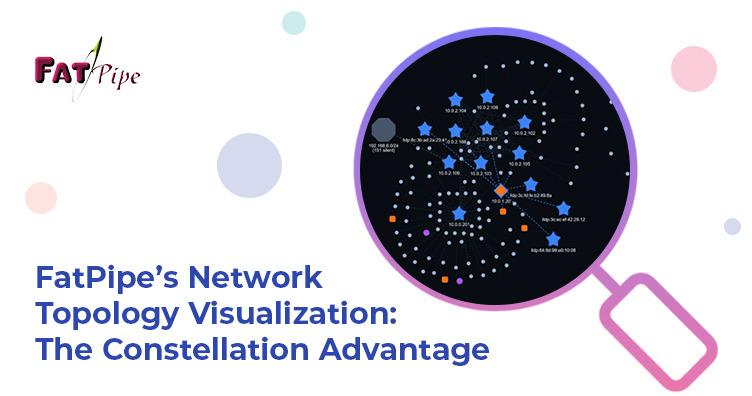
The topology map shows all automatically discovered devices and their connections in a graph layout. Using SNMP and other proprietary methods, FatPipe visualizes all devices as nodes and connections as edges on a network graph.

Addressing Scale, Distribution, and Daily Operational Impact in Distributed Environments

While SNMP and flow-based monitoring are supported, EnterpriseView also observes traffic directly in the data path. This provides continuous, real-time visibility for sectors such as schools, healthcare, and government. Rather than relying solely on periodic polling or exported data, network admins have real-time visibility. For example, a topology map gives school IT teams quick visibility across all campuses, helping address the challenges of scale, distribution, and daily operational impact.

Seeing Device Health More Clearly from One Portal

EnterpriseView extends device visibility by monitoring key device parameters such as interface traffic statistics, temperature, voltage, bias current, and transmit and receive optical power levels. This information gives administrators a clearer view of device health and network performance from a single portal. With these monitoring statistics available in EnterpriseView, teams can generate meaningful alerts, graphs, and reports to better understand what is happening across the network.

FatPipe managed services support network visibility and service monitoring across customer environments. However, many customers still face a specific pain point: even when the network path, WAN performance, and service availability are being monitored, they may not have enough visibility into the individual devices sitting at the edge.

FatPipe provides value to both existing and new customers by extending EnterpriseView from WAN and circuit-level visibility to device-specific monitoring at the network edge. By discovering edge devices and monitoring device-level parameters, FatPipe helps customers move beyond simply knowing that a network issue exists. They can begin identifying which device, interface, or site may be contributing to the problem.

FatPipe’s network topology map brings this visibility together in a practical, easy-to-understand view, reflecting FatPipe’s focus on helping customers see, manage, and troubleshoot their networks with greater confidence. FatPipe helps address network complexity with simplicity, giving customers clearer visibility and greater control over their network environments.

Please Like and Share
12 Jun

When Disaster Strikes: Why FatPipe VPN Site Failover Matters

Enterprises, manufacturing, schools, and governments, may invest heavily in disaster recovery sites to protect business continuity They have already found a solution for their enterprise-grade network. But the bigger question is this: can they afford to let the strength of that solution weaken because the network path supporting it is not equally resilient?

Your DR Investment Deserves an Equally Resilient Connectivity Strategy

FatPipe VPN Site failover does not replace the customer’s disaster recovery strategy; it is a strategic complement that ensures that site-to-site VPN connectivity can shift from the primary data center to the specific recovery location when needed. This allows the organization’s existing investment in geo-redundancy to deliver its intended value during real-world outages.

How FatPipe Ensures Geo Redundancy During a Data Center Outage

Initially, all branch networks are connected to the Data Center site using FatPipe VPN and MPSecTM. But in case of a DC failure, the branch VPNs are automatically redirected to the FatPipe device at the DR site, which is located at another physical location. With FatPipe, the differentiating factor is tunnel health and path priority are used to automatically redirect branch VPN connectivity from the primary data center to the DR site.

VPN Site Failover is configured for VPN tunnels between remote networks because it is built for site-to-site continuity. Its purpose is to keep branch offices, data centers, and disaster recovery locations connected as part of a resilient enterprise WAN design. This reflects FatPipe’s long-standing principle of maintaining business connectivity through intelligent path selection, tunnel awareness, and automatic failover when a primary site or path becomes unavailable.

Why FatPipe VPN Site Failover Still Remains Critical Today

As organizations become more dependent on distributed branches, centralized applications, hybrid infrastructure, and always-available connectivity, disaster recovery can no longer focus only on servers and storage. The network path to the recovery site must also be ready to fail over when the primary data center becomes unavailable. This is where FatPipe VPN Site Failover becomes critical.

In real-world deployments of Manufacturing, Pharma and other industry verticals, FatPipe’s VPN Site Failover capability provided a critical component for the branch locations as they could maintain VPN connectivity during a data center failover scenario. That field experience remains highly relevant today as organizations revisit their disaster recovery strategies and look for practical ways to strengthen georedundant network access.

A DR site is only as effective as the network path that keeps it reachable. FatPipe VPN Site Failover completes the continuity strategy by ensuring that site-to-site VPN connectivity can shift to the specific recovery location automatically, preserving the effectiveness of the solution the organization has already built painstakingly.

Please Like and Share
05 May

Security Without Complexity: FatPipe’s Practical Approach to EDR

Modern businesses are asking a simple question: how do we improve security without adding more operational complexity? Recent reports indicate that 63% of large organizations feel exposed, while 78% of small businesses fall into low or very low cyber resilience categories.

That is where FatPipe’s approach to Endpoint Detection and Response (EDR) stands out. It helps simplify enforcement while maintaining continuous, in-depth protection.

FatPipe’s Approach to Endpoint Detection and Response (EDR)

FatPipe builds detection and response into a central control point, reducing the need to manage every device individually.

The result is strong, ongoing protection without the operational burden that often comes with traditional EDR deployments.

Intelligent Detection Without Blind Spots

When unusual activity occurs or a system fails to respond as expected, FatPipe can generate alerts in real time.

This means security is not limited to static rules or predefined patterns. FatPipe uses behavioral awareness across the network to identify suspicious activity as it happens.

Context-Aware Response Without the Noise

FatPipe provides response capabilities through its EnterpriseView 3 (EV3) platform. EV3 can take action at multiple levels, allowing the system to respond based on the severity and context of the issue.

Rather than overwhelming IT teams with noise or forcing rigid responses, FatPipe helps ensure that minor issues are contained before they grow, while critical threats are handled quickly and decisively.

Continuous Enforcement Beyond the Endpoint

Even if a user device is misconfigured, compromised, or outside normal visibility, FatPipe continues to monitor and enforce security policies on the traffic passing through the network.

This addresses a key limitation of endpoint-only solutions. Security is enforced not only on the device, but also at the network layer.

Automated Containment Without Added Complexity

When a threat is identified, the system can automatically contain it by stopping malicious activity, restricting access, or isolating the affected environment. Once the issue is resolved, normal operations can be restored without unnecessary manual steps.

This automated, context-aware approach helps reduce response times while minimizing the need for manual intervention during critical incidents.

Breadth Through SIEM, Depth Through EDR

FatPipe combines broad visibility with targeted enforcement. Its SIEM capabilities provide visibility across traffic, interactions, events, flows, and anomalies.

EDR adds depth by ensuring that enforcement is not dependent on a single endpoint. Even if one device is compromised, security remains active at the network layer, helping prevent threats from spreading.

Designed for Simplicity, Built for Scale

FatPipe has always focused on making complex networking and security environments easier to manage. With an intuitive GUI and an adaptive architecture, FatPipe helps make security more practical for IT teams without sacrificing protection.

What FatPipe EDR Means in Practice

FatPipe EDR gives teams automated, transparent, and traceable security enforcement. It works alongside SIEM visibility so that detection can be followed by meaningful action.

The result is stronger security, fewer gaps, and less operational complexity.

Please Like and Share